PlayPump: When the Wheel of Goodwill Went Off Course

02.10.2026

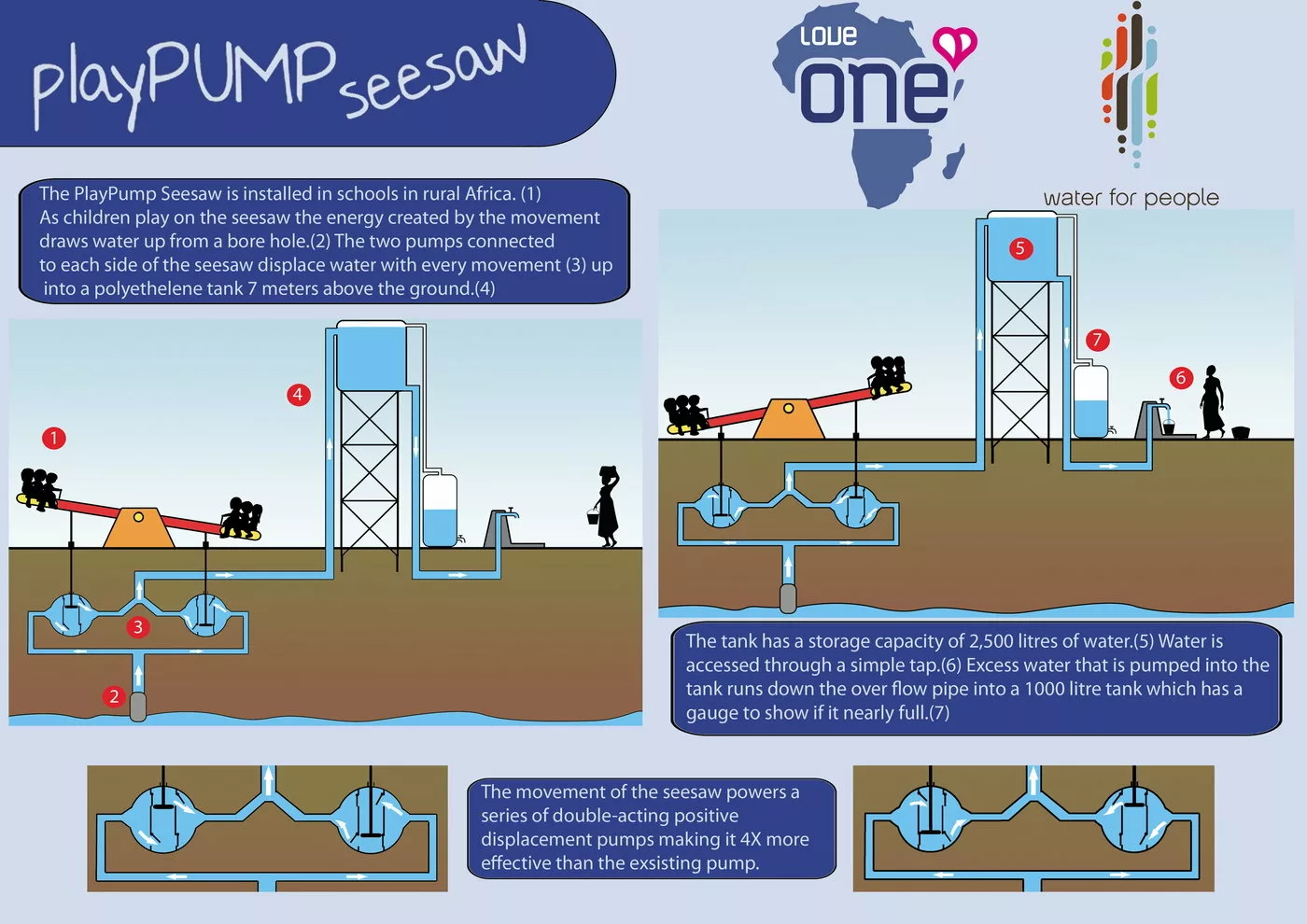
In a small rural village in South Africa, children laugh and cheer as they spin on a merry-go-round in the schoolyard. Their laughter mixes with the gentle sound of clean water flowing into nearby buckets. Two sounds that seem worlds apart are, in fact, connected by what was once hailed as a “humanitarian breakthrough”: each spin of the playground equipment pumps water up from a well into a storage tank.

The vision was inspiring ,  women would no longer have to walk long distances to fetch water; girls would have time for school; children would play; and villages would have access to clean water. This was the hopeful picture that the PlayPump project promised to deliver. With its innovative idea, PlayPump quickly drew the attention of the World Bank and gained the support of U.S. First Lady Laura Bush and the President’s Emergency Plan for AIDS Relief (PEPFAR). In 2006, PEPFAR announced a 60-million-dollar public–private partnership, with 10 million from the U.S. government, to install thousands of PlayPump systems across Africa.

But beneath the praise, what was once celebrated as a model of “sustainable development” soon became a symbol of a costly failure.

The Dream of a Joyful Wheel

On paper, PlayPump looked perfect. It seemed to solve three major problems at once: easing women’s burden of fetching water, keeping girls in school, and creating playgrounds for children. Each system included four advertising panels around the water tank to generate revenue for maintenance while promoting public health messages like HIV/AIDS prevention. PlayPumps International set an ambitious goal: install 4,000 systems across 10 African countries to bring clean water to 10 million people by 2010. The concept appeared flawless, simple technology, creative financing, and heartfelt humanitarian goals.
…And the Harsh Reality

In practice, however, the dream quickly unraveled.

A 2007 UNICEF report estimated that each PlayPump cost about 14,000 USD, many times higher than a traditional hand pump. Meanwhile, the “advertising revenue” that was meant to sustain the system barely materialized. Data showed that within a year of rollout, 75 percent of tanks in Zambia had no advertisements at all.

Worse still, the design based on “play energy” turned out to be unrealistic. According to The Guardian (2009), providing the minimum daily water requirement of 15 liters per person would require children to play for over 24 hours a day, an obvious impossibility. In reality, each system could serve only around 200 people if used continuously for two hours daily, far less than promised.

When the novelty wore off, the merry-go-round became a burden. In many villages, women were forced to push the heavy wheel by hand just to pump water, a task far more laborious than using traditional hand pumps.
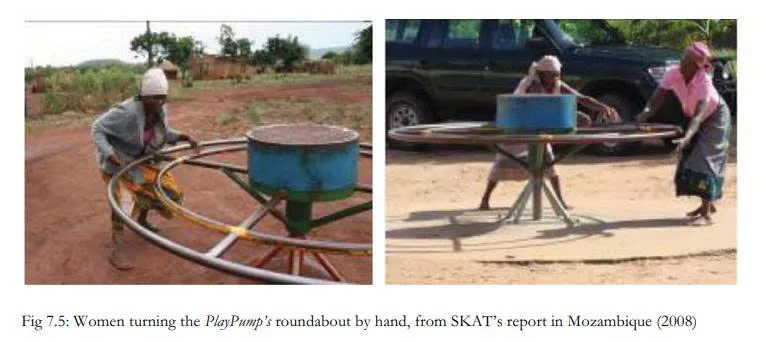
Image excerpted from the section “10 Problems with the PlayPump” in Ralph Borland’s PhD dissertation, Radical Plumbers and PlayPumps – Objects in Development (2011).

Behind the project’s shiny exterior lay a deep absence of community voice. Local residents were never consulted before installation, had no control over advertising revenue, and faced serious maintenance challenges, spare parts were unavailable locally and had to be shipped from South Africa, often taking months. What was meant to be “for the people” ended up being a burden on the people.

The End of a Beautiful Dream

Amid growing criticism, PlayPumps International eventually shut down in 2010, transferring all assets to the nonprofit Water For People. Today, that organization treats PlayPump as a niche option, used only in specific areas suited to its design. Once an emblem of “smart development innovation,” PlayPump is now a classic case study in international aid failures.

When Failure Becomes a Lesson

The downfall of PlayPump was not merely a technical misstep, it was a wake-up call about the gap between good intentions and real-world needs. A project, no matter how well-funded or praised as “sustainable,” can still fail if it lacks genuine participation from the community it aims to help.

PlayPump may have ended, but its story continues to remind us that true development should not begin with a beautiful idea, it should begin by listening deeply to the people it seeks to serve.

(Source: Internet) “10 problems with the PlayPump”:  https://objectsindevelopment.net/wp-content/uploads/2011/04/10-problems-with-the-PlayPump.pdf  

Câu chuyện khác

Omnipreneurship – A Holistic Life Philosophy for the Modern Entrepreneur
02.10.2026
Omnipreneurship – A Holistic Life Philosophy for the Modern Entrepreneur
Omnipreneurship, a term introduced by Amr Al-Dabbagh, Chairman and CEO of Al-Dabbagh Group, combines an entrepreneurial mindset with deeply human values. This philosophy guides individuals toward a meaningful and well-balanced life while creating lasting impact for society and the environment. Built upon three core principles, Omnipreneurship encourages people to live and lead with purpose: Giving: Living […]
Doing Good Better – How to Give in a Way That Truly Changes the World
02.10.2026
Doing Good Better – How to Give in a Way That Truly Changes the World
In a world faced with countless social challenges, from poverty and disease to climate change and inequality, charitable giving can no longer rely solely on emotion or goodwill. It must evolve into both an art and a science. The book Doing Good Better by philosopher William MacAskill serves as a practical guide for anyone seeking to use […]
An Examination of Altruism Through Edward Osborne Wilson’s Anthropological Narrative of Ant Societies
02.10.2026
An Examination of Altruism Through Edward Osborne Wilson’s Anthropological Narrative of Ant Societies
In nature, ants are a vivid example of highly organized social life. A colony functions as a “superorganism,” in which each individual performs a specialized role that serves the collective. Worker ants tirelessly search for and transport food, soldier ants bravely defend against intruders, and the queen focuses on reproduction to maintain the colony’s lineage. […]
Charity & Philanthropy: Distinct Yet Complementary
02.10.2026
Charity & Philanthropy: Distinct Yet Complementary
Since the late nineteenth century, Andrew Carnegie, considered the founding father of modern giving, strongly criticized both posthumous bequests and indiscriminate acts of charity. He believed that wealth should be utilized during one’s lifetime to create communal value, famously asserting that “to die rich is to die disgraced.” Source: Serudsindia From there, a new dividing […]
Amy Schiller and a New Vision for the Philanthropic World
02.10.2026
Amy Schiller and a New Vision for the Philanthropic World
Amy Schiller’s book The Price of Humanity offers an inspiring call to action for the modern world of philanthropy. For Schiller, philanthropy must become a force that nurtures the full flourishing of humanity, transcending mere survival or the pursuit of efficiency to embrace our highest potential. Schiller invites us to reimagine philanthropy, shifting from a transactional mindset […]
The Eight Golden Rungs of Charity and a Timeless Humanistic Philosophy
02.10.2026
The Eight Golden Rungs of Charity and a Timeless Humanistic Philosophy
In the 12th century, Moses Maimonides (1135–1204), philosopher, physician, and Jewish rabbi, codified one of the most distinguished humanistic doctrines on charity: Eight Levels of Charity. This is a hierarchical table of charitable acts, from lowest to highest, determined by the degree of respect and support given to the recipient’s dignity. This doctrine carries not […]
You, not anyone else, are the future of philanthropy
02.10.2026
You, not anyone else, are the future of philanthropy
In her deeply moving and inspiring presentation, Katherine Fulton, President of the Monitor Institute, a strategist, and an educator devoted to social change, invited us to look again and redefined a concept that seems so familiar: philanthropy. Katherine Fulton, President of the Monitor Institute. We often think of philanthropy as something reserved for the wealthy, […]
“Ròm”: Reflections on who truly needs help and what constitutes ‘help enough’
02.10.2026
“Ròm”: Reflections on who truly needs help and what constitutes ‘help enough’
Awards: “New Currents” Award at the 2019 Busan International Film Festival; “Best First Feature” at the Fantasia International Film Festival; “Most Popular Feature Film” at the Mai Vang Awards Amidst the blaze of headlights, the dense high-rises and the pulsating rhythm of city life, Ròm appears as a persistent scratch, muted yet enduring. The film […]
TED Talk – “We Can All Be Philanthropists” – James Gough
25.08.2025
TED Talk – “We Can All Be Philanthropists” – James Gough
“Finish school first, make money, become successful—and then you can do philanthropy however you like.” If you’ve ever heard or believed this, Dr. James Gough—military doctor, tech social entrepreneur, and now a senior leader in the technology industry—invites you to think again. In his powerful and emotional talk, James poses two profound questions: Why do […]